
The Human Pulse of a Live Wedding Painting: Love, Presence, and Attention.

Updated: Aug 26

The Pulse of a Live Wedding Painting.
At a wedding, I often stand a little outside the center of the action with a brush in my hand. The ceremony, conversations, music, weather, and changing light continue around me while I work. Someone laughs behind me. A parent becomes emotional. A cloud changes the color of the landscape. The timeline shifts. Meanwhile, I am painting. After decades of practice, some parts of that process happen almost instinctively. My hand mixes a color, adjusts an edge, or corrects an angle without requiring the effort those decisions once demanded.
But I do not want that fluency to make me absent. At the center of my work is one conviction:
Presence is love.
Art as a Living Entity
When I call a painting a living entity, I do not mean that the canvas itself is alive. I mean that the artwork exists inside a living network of relationships between artist, subject, place, memory, viewer, family, and time. A painting can be technically accurate and still feel empty. Under other circumstances, something can emerge that feels emotionally alive.
I think about this through old ideas such as anima, soul, breath, or vital force, the sense that life is more than correct anatomy or outward appearance. Michelangelo’s The Creation of Adam gives me a powerful visual metaphor for this: the body is already formed, but the image centers on the instant in which life seems about to pass into it.

As a live wedding painter, that is part of my responsibility. The live wedding painting process asks for something beyond visual accuracy. Photography can preserve extraordinary visual truth, and illustration can describe form with great precision. My task as a painter also asks for something pictorial: rhythm, color, gesture, brushwork, atmosphere, movement, and the accumulation of decisions that give the image its own breath. The paint becomes its blood, the brushstrokes its movement, and something of the artist’s attention becomes its pulse.
I cannot manufacture a soul through technique alone. But I can remain present enough for the people, place, emotion, and experience around me to enter the painting. When that happens, the result can carry something viewers feel before they are able to explain why.
That is where love begins to become attention.
When Love Becomes Attention
“Whatever you do, work at it with all your heart.” Colossians 3:23
This idea first stayed with me through a line sung by Caetano Veloso in Sozinho, which I heard in 2011 while living in Brazil and learning Portuguese: “Quando a gente gosta é claro que a gente cuida.” When we care for someone, of course we take care of them.
I later returned to the same thought in Inside the Mind of a Live Wedding Painter, phrasing it as “Quem ama, cuida”: those who love, care. I have also explored how care must include care for oneself if love is to remain healthy and sustainable in Crafting Your Happily Ever After.
When you love someone, the best thing you can offer is your presence. How can you love if you are not there?
The first mindfulness mantra taught by Zen Master Thich Nhat Hanh is “Dear one, I am here for you.”


I feel genuine affection and gratitude toward my clients. Their love for each other inspires me, and sometimes I notice that feeling through the people watching me paint.
Guests, planners, and other vendors often mention how I continue talking with people while I work, or how much I smile while I paint. I am usually unaware of my own expression. Then someone points it out, and for a moment I check in with myself. I notice the smile on my face and realize they are right. I am happy. I am standing at an easel, surrounded by people celebrating love, doing the work I have devoted my life to learning.
Their comments become a small mirror. They remind me that the emotion I bring to the painting is already visible in my body, even before I consciously name it.
I believe love is beautiful, and that some basic part of us is intuitively drawn toward what is good for us because we recognize its beauty before we can fully explain it. I believe grace can become visible in painting too. When a mark is made with care, ease, and genuine attention, it often carries a natural rhythm and tenderness that makes the image attractive. A viewer may feel that quality before understanding where it comes from. The way something is made becomes part of what that thing is, so the affection and intention present during the process remain, in some form, within the finished painting.
In painting, care is a source of inspiration, but it also takes a practical form. It changes how closely I look.
When I spend hours observing a couple with admiration, noticing the people who love them, and sincerely wishing them well, that state of mind affects my decisions. I may notice a quiet expression, the way their hands meet, or the glance one gives when the other is looking away. I may emphasize the warmth between two figures, soften a distraction, or let a gesture remain loose because its movement feels true.
This is what I mean when I speak about placing good energy into a painting. It is not necessary to interpret that literally or spiritually. You can also understand it through mindfulness, psychology, empathy, memory, or craftsmanship. The practical truth is the same: attention changes the person making the brushstroke, so it changes the brushstroke.
That is where the human pulse of a painting begins for me.
What I Am Witnessing at a Wedding
A wedding contains an unusual concentration of emotion. Two people have chosen one another. Their families and friends have gathered, sometimes after traveling across oceans. There may be nervousness before the ceremony, relief afterward, a parent trying not to cry, children moving through the reception, and moments of affection that happen far from the formal timeline.

As a live wedding painter, I spend hours inside that environment watching, listening, and working.
I also watch the place. In Hawaiʻi, clouds can move across the mountains quickly. Ocean blues shift with the sky. Trade winds move dresses, flowers, palms, and veils. A scene that felt bright and cool before the ceremony may become warm and saturated near sunset.
I gather visual information, but I am also witnessing relationships. This is why portraiture for weddings can hold more than physical likeness. Gesture, atmosphere, place, and the distance between two bodies may say as much as the details of a face.
The camera is essential to my process because some moments last only a second. A photograph can preserve the position of a hand, a veil caught by the wind, or an expression during the vows. But the painting asks a different question. The photograph shows what appeared before the lens at one instant. I decide what deserves to remain.
I can bring two figures slightly closer within the composition, quiet a distracting object, strengthen the movement of a veil, or combine the light from one moment with a gesture from another. I am not trying to improve the wedding or compete with photography. I am shaping an accumulation of experience into one image.
That selectivity resembles memory. We do not remember every detail with equal intensity. A voice, a color, an expression, or the feeling of the air may remain while other information falls away. This is what fascinates me about painting a love story in real time. The painting begins while the event is unfolding, then continues through photographs, recollection, intuition, and later reflection.

Why I Choose to Paint Freehand
My Live Paintings are not just plein air or copying a photo. I paint what I see live with my eyes, and I also use multiple photographs I take as references, creating unique compositions on-site from a blank canvas. But I do not trace or project them onto the canvas. I do not use a grid or an app to transfer the composition.
This is not a judgment against other artists or their tools and process. Art has always developed alongside technology. Pigments, brushes, cameras, artificial light, and digital references are all tools, and I use several of them.

My reason for working freehand is personal: I value what it does to my attention.
In portraiture, I understand the temptation to rely heavily on photographic transfer. Years of experience have taught me that likeness and realism matter deeply to people, especially when the subject is someone they love. I can understand why an artist might want to trace or transfer the outline of a photograph onto the canvas, much as a tattoo artist may use a stencil to preserve accuracy. But for me, painting has to involve more than reproducing information. I do not want to become a printing machine. I want the likeness to pass through my observation, judgment, hand, and interpretation, so that accuracy remains part of the painting without replacing the act of creation.
When I construct an image myself, I must observe proportion, judge angles, compare distances, and reconsider how every form relates to the others. I look at the reference, look at the canvas, make a decision, see what happened, and correct it. My eye, hand, memory, and judgment must participate together.
Freehand work also leaves room for my artistic voice, expressive brushwork, gesture, and visual handwriting. Brush pressure, rhythm, corrections, simplifications, hesitation, and imperfect edges become traces of the person who made the painting. Accuracy matters to me, but likeness alone is not enough. A technically correct painting can still feel empty.

I also prefer to paint weddings in oil on canvas because oil supports the kind of pictorial language I want the finished work to have. Its slower drying time gives me room to blend, revise, soften, layer, and return to an area without losing the continuity of the surface. Color can remain luminous and complex, edges can move between sharp and atmospheric, and brushstrokes can stay visible without making the image feel rigid or overly graphic. Acrylic can be wonderfully direct and effective, especially when speed and clean shapes are important, but oil gives me more freedom to build depth, atmosphere, skin tones, light, and subtle transitions over time. For a wedding painting that begins live and continues through later studio refinement, that flexibility allows the image to remain responsive from the first marks made on-site to the final adjustments made after the celebration.
The broader artistic roots of my live wedding paintings include realism and Impressionism, but also Surrealism and Pointillism. Surrealist influence gives me permission to use color emotionally rather than recording it mechanically. Broken warm and cool colors, influenced by Pointillist ideas, can make a Maui sky or reflected ocean light vibrate instead of lying flat on the canvas.
These decisions happen while the environment refuses to stay still. The light changes, guests approach the easel, the wind appears, and the couple moves on to the next part of the celebration. The reality of working as a live wedding painter in Maui gives me no perfect laboratory. I have to respond.
I was there, solving the painting by hand. That history becomes part of the object.
The Double Paradox of Mastery
Freehand painting keeps me engaged, but years of freehand practice create another problem: the process itself eventually becomes instinctive.
I began studying art seriously at thirteen. Since then, I have spent decades drawing, painting, teaching, experimenting, making mistakes, and correcting them.
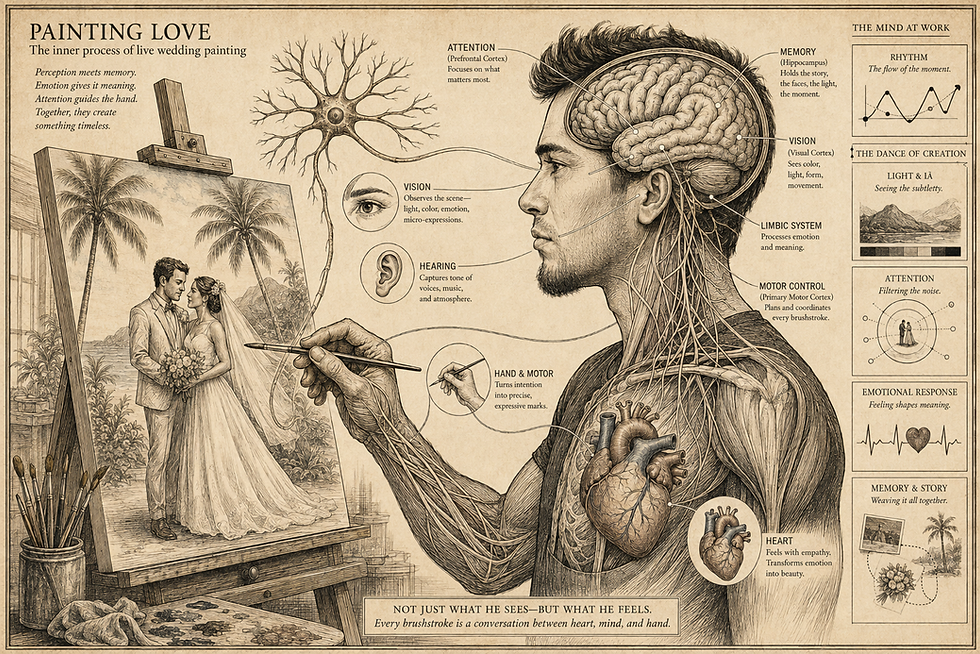
Over time, some knowledge moves from deliberate thought into the body. Proportion feels more immediate. Color mixing becomes faster. The hand begins to know things before the analytical mind can explain them.
This is one way I understand intuition. It is often technique learned so deeply that it operates faster than conscious language.

There is an old saying, often attributed to St. Francis of Assisi, that distinguishes the laborer, the craftsman, and the artist through the participation of the hands, the head, and finally the heart:
“He who works with his hands is a laborer.
He who works with his hands and his head is a craftsman.
He who works with his hands and his head and his heart is an artist.”
I am drawn to that progression, although I understand the “heart” less as emotion alone than as attention, care, intention, and presence. The hand gives form. The mind observes, judges, remembers, and solves. But something else happens when those abilities are placed in the service of genuine care for what is being painted. For me, that is where craft begins to become art.
That embodied knowledge allows flow. Instead of treating every brushstroke as an isolated calculation, I respond to the painting as a whole. Color relates to color. One edge affects another. A figure changes the balance of the background. Hesitation decreases, and seeing moves closer to responding.
Flow feels like freedom, but it contains a double paradox.
First, I choose freehand painting because it demands attention. Then, by practicing it for years, I become fluent enough to perform parts of it without much conscious effort. The discipline that helped prevent absence can itself become automatic.
I want my skills to become automatic without allowing my attention to become automatic.
There is an important difference between embodied mastery and delegated automation. Embodied mastery is accumulated knowledge operating efficiently through the artist. Delegated automation transfers part of the observing, constructing, or deciding to an external mechanism. I do not consider the second inherently wrong. I simply ask what part of my participation disappears when a tool solves a problem I still want my own eye and hand to encounter.
Yet embodied mastery has its danger too. The hand can keep working while the mind drifts elsewhere. An experienced artist may continue making competent decisions without fully encountering the people or place in front of him.
The final challenge, then, is not mastering the hand. It is continuously reclaiming the mind.
Mindful Flow
I do not reclaim attention by analyzing every brushstroke. That would interrupt the rhythm that allows intuition to work. I want something closer to mindful flow: enough surrender for experience to move freely, with enough awareness to care about what is happening around me.

At a wedding, returning to the present can be simple. Where am I? Who am I painting? What is happening in the room? Why does this moment matter?
When technique no longer consumes all my concentration, I can use that freedom to listen. I can notice the emotional temperature of the room as well as the color temperature of the painting. I may hear a father’s toast, notice the quiet way a couple touches hands, or sense how the celebration changes after sunset.
Technical ease can therefore lead in two directions. It can become autopilot, or it can create space for deeper attention.
There is also a kind of ma (間) (Japanese concept of negative space, intervals, or the "space in-between) within this flow: a quiet space between actions. Because years of practice allow much of the physical work of painting to happen without constant conscious calculation, part of my attention becomes free to receive what is happening around me. I can notice the changing light, the rhythm of the venue, a glance between two people, or the emotional shift during a toast. Instead of continually imposing technique onto the canvas, I begin listening to the celebration through the act of painting.
Technique allows flow. Flow creates freedom. Attention keeps me present. Care gives attention purpose. Love gives care its reason.
This is why I am grateful for the people who trust me to paint their weddings. Some of those gathered may never again be in the same place, under the same light. The painting may remain in the family for decades. Remembering that changes my internal state. Gratitude becomes attention, and attention enters the practical decisions of the work.
Aura, Mana, and the History Inside the Object
A live wedding painting belongs to a chain of events that cannot happen in precisely the same way again. This artist was there, with these people, in this place, on this day.

That singular history is central to what I have called the aura of a live wedding painting. Its corrections and physical marks do more than create an image. They provide evidence of how the object came into existence.
Live wedding painting is one of the clearest contemporary examples of art that still carries a strong sense of aura in Walter Benjamin’s sense of the term. Its value depends on physical presence, a specific place, and a moment that cannot be repeated in exactly the same way. In a visual culture increasingly shaped by screens, instant capture, and endless reproduction, a painting made on-site preserves something different: the evidence of a human being responding to an event as it unfolds. For me, live painting brings some of the contemplative weight of the traditional masterwork back into a fast digital world. It becomes a physical memory of the wedding, tied to its original time and place, and its significance can deepen as the years around it accumulate. Its corrections and physical marks do more than create an image. They provide evidence of how the object came into existence.
Freehand painting keeps that history physically visible. The canvas receives quick marks made during the ceremony, changes of direction during the reception, and quieter refinements made later in my studio. A preplanned transfer can establish an image efficiently, but direct observation and hand-built decisions allow the changing event to keep entering the work.
Living in Hawaiʻi has also made me attentive to the idea of mana. I use the word carefully. Mana belongs to Hawaiian cultural and spiritual traditions, and it is not simply a local synonym for “energy.” I would not claim that a technique can automatically capture it. What I can say is that people, places, actions, and objects gain significance through relationship, history, and what occurs around them. That recognition resonates with how I experience a painting made in the presence of vows, family, weather, landscape, and lived emotion.
Whether someone understands this as aura, mana, provenance, memory, or intention, I return to one grounded point: the object was shaped by participation. The hours, corrections, gestures, conversations, and changes of light belong to its history.
This distinction matters in an age of automated image-making. A computer can generate a polished and emotionally affecting image. I do not need to deny that to value handmade art. What interests me is the relationship between an object and the human actions that caused it to exist.
A generated image may resemble a wedding painting, but it did not stand beside the ocean, adjust to the trade winds, listen to the vows, speak with the guests, or reconsider the color of the sky as the light changed. The meaning I want to protect is human participation, where participation forms part of the work.
That is also why I sometimes think of a wedding painting as a talisman. I use the word personally, not scientifically. I cannot trap love inside oil paint. I can make an object physically shaped by sustained attention to love.
To understand what a live wedding painting is, we have to look beyond the final image. Its history begins while the celebration is still happening.
I want the painting to remember how the wedding felt.
The Painting’s Life After the Wedding
During the reception, guests gather near the easel and watch the image develop. Some return several times and notice that figures have appeared, the sky has changed, or a familiar detail has begun to emerge. By later in the reception, or by the time the event is ending, the painting is usually visually complete enough to read as a finished artwork for the couple and guests. The composition is established, the main figures are present, the atmosphere is there, and the painting already feels whole, even though I may still refine faces, color relationships, edges, and smaller details afterward in the studio.
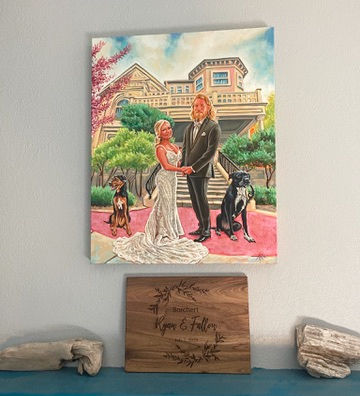
Later, I bring the painting to my studio. I refine faces, strengthen the composition, adjust color relationships, and give the work the time it needs. Then it begins a quieter life in the couple’s home.
This is why decisions about canvas size, color, lighting, and customization matter.
I am thinking about the artwork on the easel and about the wall where it may live for decades.
The painting may hang in a living room, bedroom, hallway, or family space. The extraordinary day inside it begins to coexist with ordinary ones. The couple walks past it on a Monday morning. They see it after an argument, on an anniversary, or while telling a child who the people in the background are.
The physical canvas remains stable, but its meaning changes because the people looking at it change. Ten years of marriage give the image a history I could not have painted in advance. A small figure in the background may become precious because that person is no longer alive. A child may grow up seeing the painting as part of the family home.
The work participates in memory rather than merely storing it. This future life is part of why being a live artist means more to me than producing an image in front of an audience. Observation, interaction, changing weather, mistakes, instinctive decisions, and studio refinement all belong to the same object.
The wedding ends. The painting continues.
Keeping the Human Pulse Alive
This is what love through art means to me. It is a way of working: being there, looking carefully, trusting intuition without becoming absent, and making decisions with attention rather than indifference.
Years later, the couple may not remember what song was playing when I made a particular brushstroke or who stood beside the easel when I changed the sky. They do not need to. Those moments have already participated in the making of the object. Their evidence remains as a color, a gesture, a correction, or a mark of the hand.
Someone was there.
Someone looked closely.
Someone cared.
That is the human pulse I hope remains in every live wedding painting.


Comments