
Inside the Mind of a Live Wedding Painter

Metacognition, presence, and what guests don’t see while I'm painting

TL;DR
Live wedding painting may look calm, but it is high-focus cognitive work happening in public.
My mind runs a constant internal dashboard: structure, timing, emotional truth, and guest experience.
Years of practice have rewired how I see, decide, recover, and stay present under pressure.
Couples are not only hiring a painter. They are investing in an experience, a memory anchor, and a meaningful heirloom.
At the deepest level, this work is about love as care: protecting the moment, the atmosphere, and what the painting will carry forward.

Aloha, I’m Ariel Quiroz, and when people watch me paint live at a wedding, they usually see a calm artist at an easel, smiling, chatting, and slowly turning a blank canvas into a beautiful scene.
The idea for this article came during the Milano Cortina 2026 Winter Olympics, when freestyle skier Eileen Gu delivered a viral response about her mental process, describing how she treats her brain like a scientist treats an experiment, observing, adjusting, and shaping her own thinking to improve performance. Her answer caught my attention because she described herself as deeply introspective, said she journals and breaks down her thought processes, and explained that she approaches her own brain in what she called “a tinkering scientist way” so she can keep becoming better tomorrow than she is today. She also framed that mindset through neuroplasticity, saying that at 22, she can “literally become exactly who I want to be,” and that she wants to become the kind of person her 8-year-old self would admire. That landed with me immediately, because live wedding painting has taught me something similar: the artwork is visible, but the real performance starts in the mind.
What they do not see is the mental work underneath it all. Live wedding painting is not only about brushstrokes. It is about perception, timing, emotional regulation, storytelling, and the ability to stay fully present while solving problems in real time. In many ways, it is a public performance of focus, intuition, and care. If you are new to the world of live wedding painting, this piece is my attempt to show what is really happening beneath the surface while the painting is taking shape.

What People See vs What Is Really Happening
When people watch me paint at a wedding, they usually see something calm and relaxing - a smiling artist at an easel, a few confident brushstrokes, and a canvas slowly becoming a memory. I understand why it looks effortless, because part of my job is to make it feel accessible and enjoyable to watch.
The biggest misunderstanding is that art is mostly emotional and spontaneous, when in reality it’s closer to active problem-solving. Artists aren’t waiting for inspiration to land. We’re applying composition, color theory, and technical knowledge from the very first mark. Years of practice are what make it look easy, because practice trains muscle memory and intuition, and the viewer only sees the smooth surface of all that work.
That’s why live painting can feel almost magical. People see me working with my hands, but I’m working with my brain the whole time. For me, painting is fundamentally cognitive. It refines perception, stimulates imagination, and it can even transform consciousness. Leonardo da Vinci had a phrase for this: La pittura è cosa mentale - painting is a mental thing.
Another misunderstanding is the messy middle. There are stages where it looks awkward or unfinished, and guests assume I “messed up.” Most of the time, that ugly layer is intentional groundwork. I’m thinking several steps ahead because I know the early structure is what makes the final result work.
Non-artists see the subject first, like a bride in a white dress. The artist sees raw data: shapes, color temperatures, hard versus soft edges, and 3D forms translated into 2D geometry. It’s constant decoding, and it’s mentally exhausting because I’m managing technique, shifting light, moving subjects, environmental conditions, and guest interaction for hours.
The first 10 minutes are where that invisible work is the most intense. I feel that early adrenaline, and I remind myself of the miles of canvas I’ve covered:
“Ariel, remember you are a good painter, you got this. You know these colors. You know this light. This isn't your first rodeo, it’s just your latest masterpiece. Inhale the love in the air, exhale with a smile, it’s another beautiful day in paradise, and you are doing what you love to do.”
Then I lock in the structure fast - composition, perspective, horizon lines, background color - because a slightly tilted ocean line can quietly ruin the emotional feel of the whole piece. By the time most guests start paying attention, the hardest puzzles are already solved, and that frees me to spend the rest of the event on emotion, detail, and storytelling.
When I arrive, I do pay attention to layout, timeline, and light, but before all of that I like to inhale the energy of the location, feel the mana of the place, and offer my ha, my breath and presence, in return. Then I go practical: find the clean sightline, sync with the coordinator so the center of the canvas is ready for the key moment, and track where the Hawaiʻi light is headed, not just where it is now.
Underneath all of that is one guiding question: what is this painting really about? In Hawaiʻi, it’s easy for paradise to start looking familiar if you let it. My job is to make a world-famous view feel like it exists for this couple only. I decide that by using a simple internal compass: the couple’s story from our consultation, the unique spirit of that specific day, room for happy accidents that capture real energy, and ruthless editing so the painting becomes a masterpiece of memory instead of a literal recording.
The Mental Dashboard in Real Time

When I paint live, my mind runs like a dashboard. I’m not thinking in long paragraphs while I work; I’m checking a few gauges on repeat to keep the painting on track and the experience feeling smooth. That constant self-monitoring is a big part of why my on-site workflow stays calm and structured, even when the light shifts and the timeline moves fast, and it’s also why my live wedding painting process is designed around momentum, not perfection.
The Structural Gauge (composition and values).
Every 10 to 15 minutes, I squint. It wipes out the details and tells me the truth. Are the big light and dark shapes balanced? Is the ocean getting too dark and weighing down the mood? If the structure is off, no amount of detail will save it.
The Soul Gauge (likeness and energy).
Once the structure is stable, I check silhouettes, posture, and spacing. The question is simple: Does this feel like their connection, or does it feel like a generic pose? I’m checking likeness, and I’m also checking emotional truth.
The Clock Gauge (timing).
I paint with internal milestones. By appetizers, the background should be mostly resolved. If I’m behind, I simplify the periphery immediately so I can protect the time and attention needed for the couple’s faces and focal details.
The Aloha Gauge (presence and experience).
This one is huge. I’m watching my body language, my pace, and the energy I’m giving off. Am I grounded? Am I approachable? Am I creating calm around the easel? The painting is the artwork, and my presence is part of the service.
Peripheral Presence
A big part of this work is staying warm without losing focus. I call it peripheral presence. I’ve trained my attention to work in two layers at the same time: the technical core and the social shell. One part of me is solving the painting, and another part stays open and welcoming.
When guests approach, I shift into larger, more automated passages - sky, foliage, lawn, atmosphere - where muscle memory can carry the brush. That lets me make eye contact, answer questions, and be genuinely present without losing my place. Then I save the high-intensity work - faces, hands, lace, critical edges - for natural pockets of space, like when guests drift toward cocktails, speeches, or the dance floor. I’m not choosing between being friendly and being focused. I’m managing rhythm. Inside the Mind of a Live Weddi…
The 30-Second Pivot
Mistakes happen in public. The difference is what happens next. In public, I don’t panic. I pivot, because guests are watching my reaction as much as the canvas.
Seconds 1-5: I classify the miss fast. Wrong value? Wrong temperature? Wrong placement? Or a possible happy accident?
Seconds 6-15: I choose the fix. With oils, a major mistake can often be corrected quickly, scrape, wipe if needed, rebuild.
Seconds 16-30: I execute calmly, without drama, and I move on.
Experience is knowing what needs to be perfect now versus what can be refined later in the studio. The live experience and the emotional impact come first, then I finish the heirloom with fresh eyes.
What Practice Rewired in Me As A Live Wedding Painter
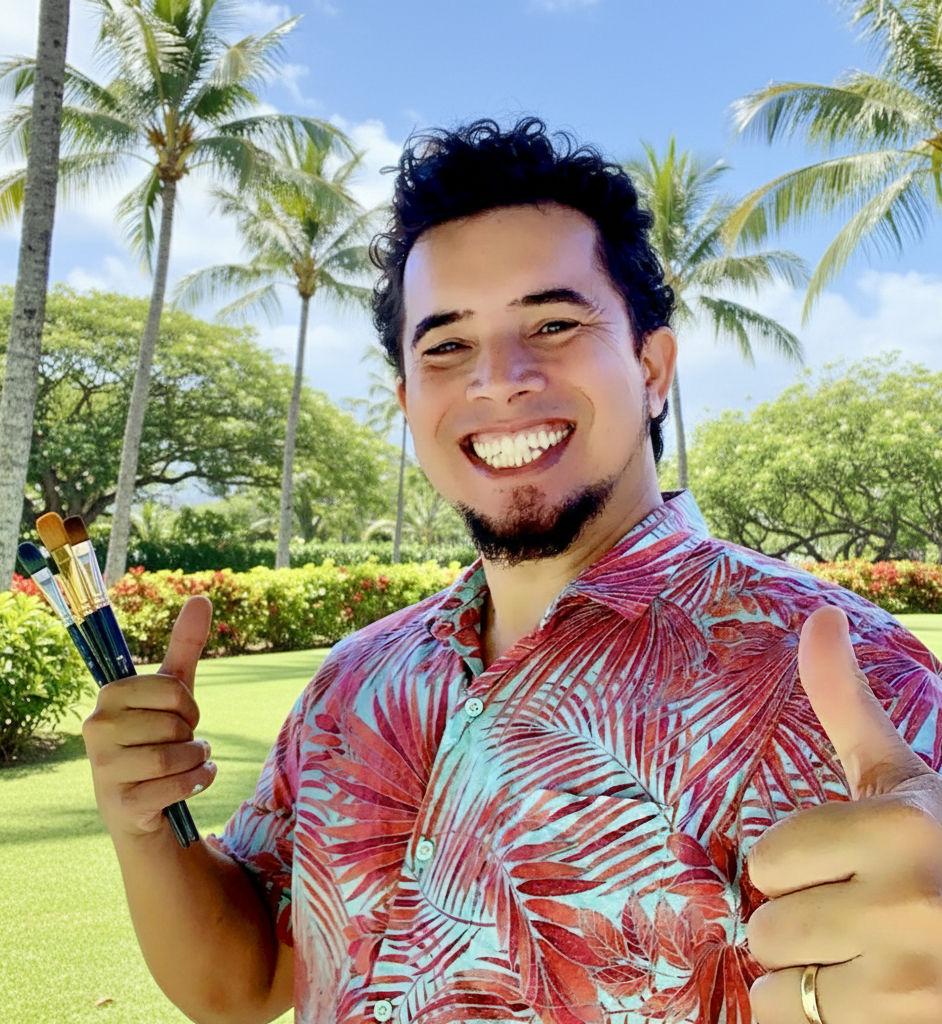
After more than 20 years of painting, I genuinely believe practice has changed the way my mind works. I do not mean that in a vague motivational way. I mean it functionally. I cannot show you my own brain scan, but from the inside, yes, I believe practice rewired the way I perceive, decide, and recover.
The first thing it rewired was how I see. Earlier in life, I saw objects first. Now I see structure first. I see the architecture beneath a scene the way an engineer reads a building: balance, proportion, perspective, weight, rhythm, and the invisible framework that makes an image feel believable before the details even arrive. I am not only seeing a bride, a groom, a floral arch, and an ocean. I am reading how those forms relate to one another, how the negative space carries connection, how the horizon stabilizes the world, and how color temperature, edge hierarchy, and value design hold the mood together. That way of seeing was built through repetition, correction, failure, observation, and thousands of hours of deliberate work. It is also part of the deeper visual language behind the artistic roots of my live wedding paintings, where realism and impressionism are only part of the story.
The second thing practice rewired was my attention under pressure. Live wedding painting trained me to hold a focal task while staying socially present. I can track composition, timing, shifting light, guest interaction, and emotional tone at the same time without feeling mentally split. That did not come from talent alone. It came from disciplined repetition. What people often call talent is usually the visible result of trained observation, muscle memory, compositional decision-making, and systems repeated so many times they begin to feel natural. Maybe talent helps someone begin. What makes an artist dependable under pressure is earned craft.
Practice also rewired how I handle mistakes. Earlier in my career, a wrong mark could hijack my mood for minutes. Now I can feel the stress signal, slow it down, and convert it into action much faster. That changes the painting, and it changes the atmosphere around me. Guests feel what I project. If I stay calm, the space stays calm. If I spiral, the tension spreads. So emotional regulation is not separate from the art. It has become part of the art.
And maybe the biggest shift is decision speed with discernment. Practice did not just make me faster. It made me faster at choosing what deserves attention. That matters because control is essential in some areas and harmful in others. I need control over the structural level: composition, proportion, horizon lines, value design, timing, and my own pace. That is the skeleton of the painting. Without it, the story can collapse. But too much control can suffocate the work. If I over-manage every edge, every ripple, every hair, the painting loses oxygen. Some of the strongest passages happen when I loosen my grip just enough for intuition to enter. A broken edge becomes atmosphere. A bold stroke becomes movement. A happy accident becomes energy.
That balance between control and freedom is where flow lives. Control protects the foundation. Intuition gives the painting its pulse. What people sometimes experience as intuition is really trained pattern recognition. My brain has seen enough changing light, shifting poses, color problems, and timing pressure that I can make fast decisions without overthinking every move. That is why live painting can look spontaneous from the outside while feeling highly structured from the inside.
And this rewiring does not stay inside the frame of the canvas. Live wedding painting has changed the way my mind works outside of art too. I spend my working life inside celebrations of love, and that affects me. It has reinforced my romantic side, strengthened my gratitude, and made me more intentional in my own marriage. It has also changed how I move through business and everyday life. I think in layers now: what is structural, what is emotional, what is urgent, and what can wait. I do not treat every problem like a crisis. I treat it like a composition problem. Even outside of painting, I walk into spaces reading mood, rhythm, tension, and energy almost automatically.
If I had to say it simply, live wedding painting trained more than my eye or my hand. It trained my heart, my nervous system, and my way of relating to people. I thought I was learning how to paint love stories. In many ways, I was also learning how to live one.
Pressure, Failure, and Recovery in Public

There are lessons I could only have learned in public. The studio can teach skill, patience, and refinement, but it does not move the way a live wedding moves. At a wedding, the light shifts, the wind changes, timelines compress, emotions rise, and people are watching while you work. That environment exposes weaknesses fast, and it forces growth fast too.
One of the clearest moments came after the Lahaina fires, during a season of grief and rebuilding that I reflected on more deeply in Lahaina: One Year Later - A Journey of Resilience, Rebirth, and Cultural Preservation. In September 2023, I had a wedding on the south side of Maui that still moved forward. It was one of my first events after the fires, and technically, I could do the job. Emotionally, I was not fully processed. My wife and I were carrying stress, displacement, debt, and trauma, and I was more fragile than I wanted to admit. Guests were kind, supportive, and warm, but that almost made it harder. Most of the time, I wanted to cry.
What that day exposed in me was a weakness I did not fully understand before: I thought professionalism meant I had to be emotionally seamless. I thought being professional meant nothing could show, nothing could shake me, nothing could hurt. What I learned is that real professionalism is different. It is not pretending nothing hurts. It is learning how to stay present, protect the experience, and still honor your humanity. That event taught me that resilience is not emotional numbness. It is regulated honesty.

It also changed how I prepare now. I do not only prepare canvases, brushes, and colors. I prepare my nervous system too. I ground myself, I breathe, I simplify what can be simplified, and I make room for being human while still delivering with care.
Public failure taught me something else much earlier: being a good painter and being a good live wedding painter are not the same skill. My first paid wedding painting made that very clear. In the studio, light stays where you put it. At a wedding, everything moves - sun, clouds, wind, atmosphere, people, timeline, energy. I learned quickly that I needed more outdoor practice, more respect for shifting conditions, and a better understanding of what can actually be painted clearly in real time.
I also learned a humbling technical lesson: small human figures are hard. When the couple or guests are too small in the composition, every tiny proportion error becomes visible. A small mistake in head size, posture, or gesture can make a figure feel stiff or off. That taught me to respect scale, simplify earlier, and never build a composition that depends on tiny perfection everywhere.
But the deepest lesson was recovery. In the studio, if something goes wrong, you can pause, restart, hide the struggle, or come back tomorrow. In public, you recover while people are watching. You learn to make decisions faster, protect your body language, and solve problems without letting panic become part of the performance. That is part of the same care behind how I keep your wedding safe and beautiful while painting live. Safety is not only practical. It is emotional too. Couples need to feel that I am steady, and guests need to feel that the easel adds to the celebration instead of creating tension.
Public pressure taught me triage, pacing, composure, and humility. The studio taught me painting. Public failure taught me performance.
Who I Become While Painting Live

When I paint live at a wedding, I am not only a painter. If I had to choose one phrase, I would say this: I become a grounded steward of the moment. To me, that means staying fully present while tending to the atmosphere, protecting the couple’s emotional truth, and adapting in real time without letting pressure take over the room.
Yes, I am the artist building the image. But I am also a witness, because I am present for something real. I am a performer because I am creating in public, in real time, under pressure. I am a storyteller because every decision I make shapes what the memory will emphasize later. And I am a host, in a way, because my easel becomes a small gathering place inside the celebration. At a wedding, I am not only making a painting. I am managing the atmosphere.
What makes that role special is that my mind is constantly shifting between internal roles while I work. One moment, I am the visionary, feeling the mood and sensing what the painting can become. The next moment, I am the witness, observing light, timing, posture, proportions, and space with objectivity. Then I become the editor, refining, simplifying, and protecting what matters most. That shifting is not random. It is trained. Over time, live painting has strengthened my ability to reflect while creating. I am painting, and I am also monitoring how I am painting, adjusting in real time while my hands keep moving.

That is part of why the work can look intuitive from the outside while feeling highly deliberate on the inside. My job is to stay calm, observant, and warm while the day moves fast around me. I need enough technical control to protect the structure of the painting, and enough human presence to make people feel comfortable approaching the work. That balance is one reason choosing the right artist matters so much, which is part of what I talk about in how to choose a live wedding painter. Couples are not only choosing style. They are choosing the person who will stand inside the emotional atmosphere of their wedding day.
And the honest answer is that when couples hire me, they are hiring all of it, but not all of it equally. The painting is what they take home. My presence is what their guests experience. The energy around the easel shapes the atmosphere. But the deepest thing they are really investing in is meaning, carried through memory. The painting is the heirloom. The live experience is the emotional imprint.
In practical terms, I think couples are hiring three layers of value: a meaningful artwork, a calm and professional experience, and a memory anchor that helps them revisit not only what happened, but what it felt like. In Hawaiʻi, that becomes even more powerful. A destination wedding here is already an experience by design: the ocean breeze, the golden light, the music, the people they brought across the world to be there. Live painting becomes part of that experience while it is happening, and then it becomes the object that carries it forward.
To become this version of myself, I had to let go of an older identity: the artist who thought he had to prove himself through perfection and private struggle. Live wedding painting forced me to release that. You cannot hide in this work. You cannot wait for the perfect mood. You cannot build your identity around invisible suffering when your job is to serve people in public on one of the most meaningful days of their lives. I had to let go of the fear of being seen in the messy middle, the idea that refinement and humanity are opposites, and the old myth that suffering makes art deeper. My best work does not come from depletion. It comes from groundedness, clarity, and peace.
So who am I while I paint? I am an artist in service. I am there to translate a living moment into a meaningful object while helping the experience feel elevated, personal, and memorable. That is what makes live wedding painting so unique to me. It is not just studio art brought outside. It is art, hospitality, storytelling, and a trained mind adapting in real time.
And maybe the contradiction that surprises people is this: I can seem very social while I work, but in private, I am much quieter. At weddings, I can host a room. At home, I recharge in peace. That contrast is real, and it is part of how I do this work well.
Meaning, Memory, and Human Nature

When I paint a wedding, I try to paint what it meant, but I have to move through what happened and what it felt like to get there. For me, the strongest live wedding paintings hold all three at once. I think of them as the body, the heart, and the soul of the piece.
What happened is the body.
This is the factual layer: where the couple stood, where the light was coming from, how the veil moved, what the ocean looked like, what was physically there. It gives the painting credibility. It tells the viewer, yes, this was the moment. A camera can document that beautifully, which is exactly why a painting has to do more than that.
What it felt like is the heart.
This is the atmospheric layer. Was the air electric and joyful? Was it soft and intimate? Was there laughter, wind, stillness, anticipation, tears? This is where brushwork, color temperature, edge softness, and rhythm start doing emotional work. This is where the viewer says, “I remember that feeling.”
What it meant is the soul.
This is the layer I care about most. A wedding is not only a kiss, a dance, or a ceremony under an arch. It is a public promise. It is a family becoming family. It is commitment, legacy, hope, and the beginning of a new chapter. That is why I edit so intentionally. I remove visual clutter, protect one emotional anchor, and build the painting around what matters most. If I only painted what happened, I would record the event. If I only painted what it felt like, I might create something almost abstract. When I paint what it means, I create a symbol of the promise.
That is also why live wedding paintings create such a memorable shared experience. The painting is not only something people look at later. It becomes something guests gather around, talk about, and remember together while the wedding is still unfolding.
Guests reveal a lot about themselves when they watch me work, but the biggest thing they reveal is their relationship to time, process, and meaning. Some people stand quietly and study every layer as it develops. They are patient, process-oriented, and curious about how something becomes something else. Others come up and ask, “Is it done yet?” They are not wrong, they are just wired for results. They want the final image, not the construction.
Then there are the people who start remembering. One of the most common things I hear is, “I used to paint,” or “I used to draw when I was younger.” Watching the canvas unfold wakes up something in them. For a moment, they are not only guests anymore. They are reconnecting with a part of themselves. Children are usually the most honest. Older guests often become reflective. I have had grandparents stand beside me and tell me stories about their own wedding day, or about someone they loved who is no longer here. The painting becomes a doorway, and memory walks through it.
And then there are the jokers, which I have come to appreciate. The backseat art directors, the Bob Ross references, the vanity edits, the Titanic line that somehow shows up again and again. Most of the time, those moments come from excitement, not disrespect. Humor becomes a bridge. Even the jokes reveal something: how people relate to attention, vulnerability, art, and being seen.
And in a world where people are used to screens and constant distraction, live painting reveals something else too: a real hunger for presentness. I have seen guests stand in silence for several minutes just watching paint move across the canvas. No phones. No rushing. Just attention. It becomes a quiet, almost meditative pause inside a busy celebration, and it speaks to the same idea I explore in Preserving the Aura of Live Wedding Paintings in an Age of AI: that real human presence, lived time, and the unrepeatable energy of something made by hand are part of what gives live art its aura. That is one reason I love this work so much. The easel becomes more than a workstation. It becomes a social bridge. It gives introverted guests something natural to talk about. It gives extroverted guests a show to engage with. It gives families a place to gather, remember, and reflect while the wedding is still happening. In that sense, art becomes a mirror. When people watch something being created in real time, they reveal how they relate to patience, beauty, imperfection, memory, and wonder.
What weddings have taught me is this: love is not only a big moment. It is a series of small choices made with presence. The vows matter. The rings matter. The first kiss matters. But what often teaches me the most are the quieter gestures around them: a hand squeeze, a patient glance, a steadying breath, the way someone gently adjusts a veil, the way two people keep returning to each other while everything around them is moving fast. That is love in action, not just love in language.
Commitment also looks different up close than it does in a highlight reel. From the outside, people often think commitment is the ceremony itself. But standing at my easel, I see that the ceremony is the symbol, and the real commitment lives in patterns. It is not only “I choose you today.” It is “I will keep choosing us in ordinary life.” It is a repeated choice, made quietly and consistently. Weddings have made me respect rituals more deeply because the strongest couples usually already have smaller rituals underneath the big one.
And then there is memory. People do not remember everything equally. Emotion shapes attention. They may not remember the exact order of every event, but they remember a look, a song, a laugh, a feeling in their chest, a moment when time seemed to slow. They remember peaks. They remember endings. They remember what made them feel safe, seen, and connected.
That is why I do not try to paint a perfect record. I try to create a memory anchor - something that helps people return not only to what they saw, but to what they felt and what it meant. Because in the end, people rarely remember perfection. They remember presence. They remember meaning. They remember the moments that made them feel deeply alive.
Becoming - The Person This Work Is Making Me
Over the years, I have realized the canvas is not the only thing being transformed. I am changing too. Live wedding painting has trained far more than my hand. It has trained my nervous system, my judgment, my people skills, and my character. In that sense, this work has become a training ground for becoming a whole professional human being, not just a better painter.

If my 8-year-old self watched me painting a wedding in Maui today, he probably would not recognize me at all. He would be in disbelief that the kid who grew up in extreme poverty in Chile, in a tiny rustic home with no sewage, no running water, and no electricity, somehow became a professional painter creating love stories in paradise, surrounded by ocean light, music, and celebration. At that age, I was not dreaming of weddings or Hawaiʻi. I was getting top grades, obsessed with science, big questions, and the idea of inventing things. Drawing was already there, but not yet as a career plan. It was more like a coping mechanism, a doorway, and a way of imagining another life.
What makes sense to me now is that the real thread was never consistency. It was adaptation. My life kept changing, and I kept changing with it. I moved in with my father at 10. I committed to art at 13 after being accepted into the Liceo Experimental Artístico. I moved back with my mother at 15, and my worldview began shifting from hard atheism into different forms of agnosticism. In 2001, I moved to Valparaíso to study art. In 2011, I moved to Brazil and met my wife, and something in me opened. I became more spiritually receptive without adopting any religion, moving from hard skepticism into a softer agnosticism where I could see faith as a human strength, not a logical failure. Then came Mexico, then Hawaiʻi, marriage, and eventually live wedding painting. None of that is a straight line. It is adaptation in motion. If someone wants the broader background behind that journey, it is part of my story here.
And then there is the quieter part, maybe the most important part: happiness. That 8-year-old version of me would not only be shocked by the location or the career. He would be shocked that I became a happy man. That matters because I carried untreated depression from around 14 to 29, and for a long time I could not imagine a future where I would feel genuinely lucky in love and life. Moving to Brazil changed my trajectory. It did not erase the past, but it proved something I still believe: I am not defined by where I started or only by what I struggled with. I am defined by how I adapt, how I rebuild, and how I keep finding another way.
So what kind of person do I hope this work is making me? More present, for sure. Weddings move fast, conditions shift, emotions run high, and this work has taught me to stay calm without becoming numb. More joyful too. I have intentionally let go of the starving artist myth. My best work does not come from depletion. It comes from clarity, gratitude, and peace. And more honest about meaning. Painting has trained me to filter noise, protect the emotional truth, and give my attention to what is real: connection, commitment, presence, and the people in front of me. I thought I was learning how to paint love stories. In many ways, I was also learning how to live one.
And I am still learning. What I am still trying to understand about my own mind is why focus is sometimes easier to summon for other people’s deadlines than for my own dreams. Under wedding pressure, my mind becomes a laser. In the studio, it can become a negotiator. Weddings give me beautiful constraints: clear purpose, real stakes, a fixed timeline. The studio gives me freedom, and sometimes that freedom creates friction. So one of the questions I am still living inside is how to recreate the healthy pressure of a live event inside private work without turning the studio into a stressful place. In a real way, I am still learning how to be the same person in private that I am in public: focused, calm, and committed.
Love as Care

Live wedding painting looks like art, but to me it is really about love.
I do not mean love as a vague feeling or a temporary mood. I mean love as action. In Brazil, I learned a phrase that stayed with me: Quem ama, cuida - those who love, take care. That simple truth has stayed with me ever since. Real love pays attention. Real love protects. Real love shows up prepared, stays steady under pressure, and keeps choosing what matters even when conditions are changing. That is the kind of love I try to practice through this work.
When I paint a wedding live, I am caring for more than paint and canvas. I am caring for the energy around the easel by staying calm, approachable, and grounded, because my presence becomes part of the experience. I am caring for the couple’s memory by filtering out distractions and protecting the emotional truth of the scene, so the painting becomes something they can return to years from now. I am caring for the integrity of the artwork by making smart decisions in the moment, then giving it the studio refinement it needs after the celebration ends. That deeper philosophy sits at the heart of what I believe about love through art.
Care also lives in the practical details. It is in the way I track the timeline so I am ready when the key moment arrives. It is in the way I adapt to wind, shifting light, changing layouts, and the natural unpredictability of live events. It is in the way I protect the guest experience while still protecting the final painting. None of that is separate from the art. It is part of the art.
That is why this work means so much to me. Before a live wedding painting becomes an heirloom, it is first an act of attention. It is a way of honoring the couple, the place, the atmosphere, and the promise they are making.
That is what love looks like in real time.
What the Painting Holds After the Wedding Is Over

After the wedding is over, the music fades, the flowers are gone, the guests fly home, and the day begins to move from experience into memory. That is where the painting begins its second life.
What hangs on the wall is not only a picture of a wedding day. It is a container for presence. It holds the light, the atmosphere, the symbolism, and the emotional weight of a moment that can never happen the same way again. A photograph can document what was there. A painting can hold what that moment became in the hearts of the people who lived it.
That is why I care so much about what happens both during the event and after it. The live experience matters because it becomes part of the memory, and the final artwork matters because it becomes the object that carries that memory forward. The practical side of that, from the live experience to the studio refinement, is woven into my live wedding painting process.
In the end, I do not believe I am only painting what happened. I am protecting something more fragile and more valuable than that. I am trying to preserve a feeling, a promise, and a piece of a couple’s story in a form they can keep returning to for years.
That is what the painting holds after the wedding is over: not only an image, but a living reminder that love was here.
FAQ
What makes live wedding painting different from just hiring a photographer?
A photographer captures a fraction of a second with incredible precision. I love photography, and I rely on it as part of my reference process. But a live wedding painting does something different. I interpret the moment, edit the noise, and build the image around what mattered most emotionally. The result is not only documentation - it is a curated memory, shaped into an heirloom through live wedding painting.
Do I finish the entire painting at the wedding?
I create the painting live on-site, and that is a major part of the experience for the couple and their guests. Then I usually take it back to the studio for refinement, where I can strengthen details, make final adjustments, and fully protect the integrity of the finished piece. That combination of live creation and studio polish is a key part of how my process works.
Why do guests enjoy watching a painting in progress so much?
Because it creates a real moment of presence. People are so used to instant images and screens that watching something unfold by hand can feel surprisingly powerful. Guests gather, talk, joke, reflect, and reconnect with their own sense of wonder. The easel becomes a social bridge inside the celebration, and the painting becomes part of the entertainment as well as part of the memory.
How do I stay focused while talking to guests?
I have trained myself to work in layers. Part of my attention stays locked on the technical core of the painting, while another part stays socially open and warm. I shift into broader, more automatic passages when guests come by, then return to finer, more demanding details when the moment opens up again. It is not about choosing between focus and friendliness. It is about rhythm, practice, and being fully present in both.
What are couples really hiring when they book me?
They are hiring more than a final canvas. They are hiring a meaningful artwork, a calm and professional presence, an interactive guest experience, and a lasting memory anchor. The painting is what they take home, but the atmosphere around the painting becomes part of the wedding day itself. That is one reason I always tell couples that choosing the right artist is about more than style alone, which is part of what I explain in how to choose a Live Wedding Painter.
What makes a live wedding painting feel personal instead of generic?
The difference is intention. I am not trying to paint a postcard version of a beautiful place. I am trying to paint their moment in that place. That means paying attention to emotional anchors, family significance, atmosphere, movement, and the subtle details that make one wedding feel different from another. The goal is not just beauty. It is meaning.


Comments